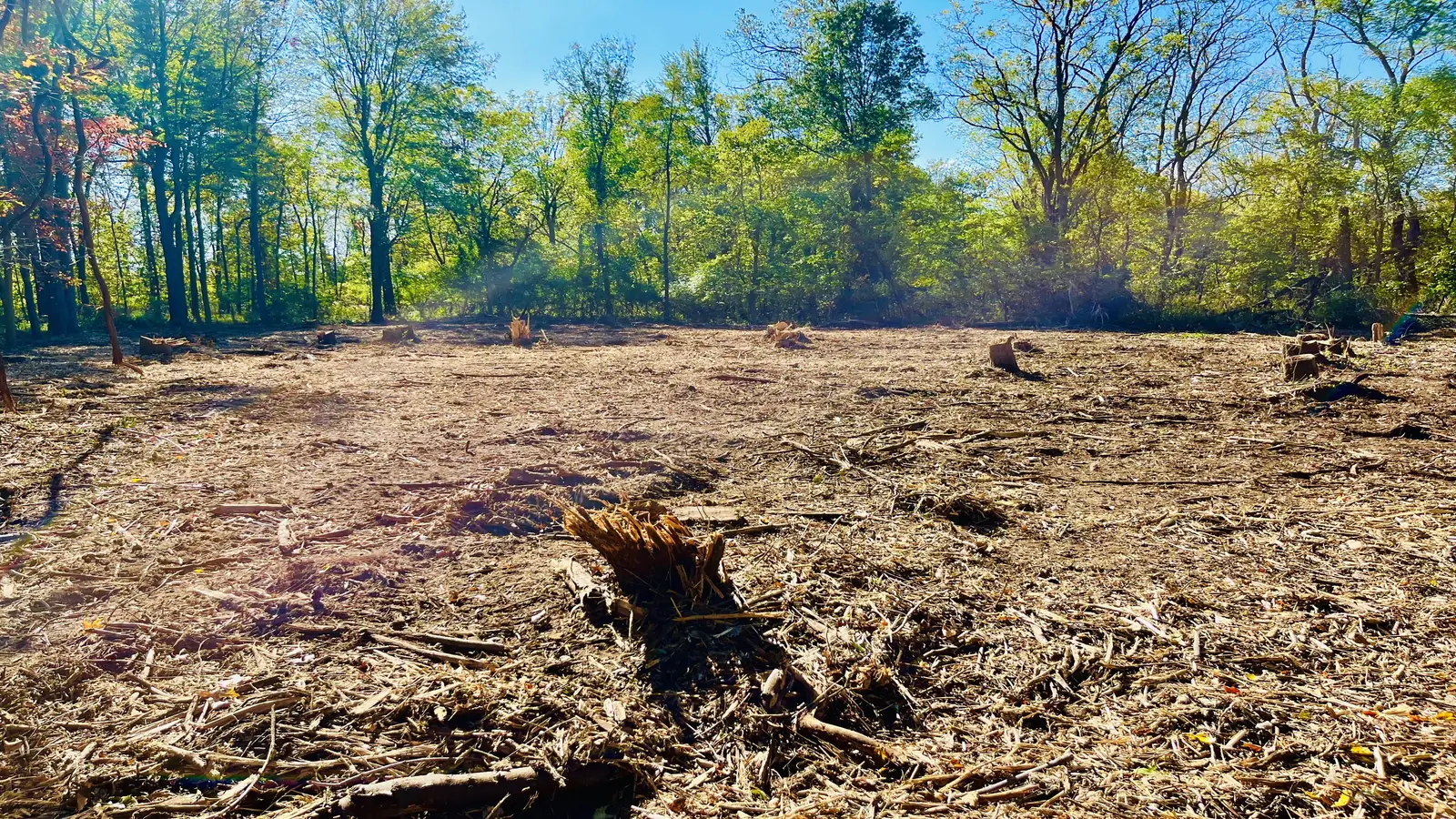
How Much Does Land Clearing Cost per Acre in Connecticut?
Published cost guides put land clearing at roughly $1,200 to $6,000 an acre. The number moves with what is standing on the ground. National cost guides price a lightly wooded acre at about $500 to $2,333. A heavily wooded acre runs about $3,000 to $6,155 in the same guides.
Those are market numbers from published guides, not our price list. Most clearing work around Monroe is not a full acre anyway. It is a house lot, a back corner, or a strip for a new driveway. That kind of land clearing gets priced by the job, after someone has seen the ground.
What do published guides say land clearing costs per acre?
Every band below comes from a national home cost guide or a contractor pricing guide. They are sorted by how thick the growth is.
| What is standing on the acre | Published cost per acre |
|---|---|
| Brush, briars and scrub | $330 to $2,500 |
| Lightly wooded | $500 to $2,333 |
| Moderately wooded | $2,000 to $3,500 |
| Heavily wooded | $3,000 to $6,155 |
One cost guide’s Connecticut page puts a cleared acre at $3,000 to $4,800. It ties the spread to how much growth is on the property. The guides do not line up with each other, and that is the useful part. Two lots the same size can hold very different work.
Why are most Fairfield County jobs priced by the job?
The lots here are small. State parcel and assessor data for 2025 puts the median house lot in Monroe at 1.03 acres. Newtown is 1.32 acres. Down county it drops fast: Fairfield 0.256 acres, Norwalk and Stratford 0.17, Bridgeport 0.115.
Cost guides price fractions of an acre too. One national guide puts a quarter acre of heavy woods at $750 to $1,539. A half acre lands at $1,500 to $3,078. Those are wide bands for a small piece of ground.
Real lots are never uniform, either. Ten big oaks near the house cost more than a quarter acre of saplings. So the estimate gets written for the lot in front of us.
What drives the price of clearing land in Connecticut?
Tree size and count come first. National guides put single tree removal at $385 to $1,070 on average. A stand of mature hardwood adds up quickly.
Then comes the ground. Stumps left in place cost less than stumps pulled out. Ledge and boulders slow every pass of the machine. The uplands here are glacial till over schist and gneiss. The federal soil survey maps a shallow upland soil in this county with hard bedrock 10 to 20 inches down.
Access and disposal fill in the rest. A lot with no way in for a machine costs more to work. Old fieldstone walls you want left standing have to be worked around. Cost guides put debris hauling at $500 to $2,000 an acre. On a wooded lot that is often the second biggest line after the trees.
Overgrown ground is its own kind of job. Briars, vines and saplings read closer to brush clearing than to felling timber.
What does stump removal cost?
Grinding and pulling are two jobs with two prices. Published guides put stump grinding at about $131 to $450 per stump. National averages land near $272 to $295. Pulling the stump and root system out runs about $175 to $525 per stump, with averages near $330 to $345. Many guides price by trunk size, at $2 to $5 per diameter inch.
The difference is what stays in the ground. Grinding chews the stump down and leaves the roots and a bed of chips. Pulling takes the whole stump, roots and all, and leaves a hole to fill and grade. We pull with excavators, so stump removal on a clearing job is usually priced into the job.
How long does land clearing take?
Cost guides put a crew at 2 to 4 acres a day on open, easy ground. A contractor pricing guide puts excavator clearing closer to 0.5 to 1.5 acres a day. Heavy woods, wet ground and a long haul road all pull that down.
A house lot is usually a matter of days. Five acres of real woods can run past a week.
Does the timber pay for the clearing?
On a house lot, almost never. Connecticut’s forest practices statute sets a floor for what counts as commercial forest products. A harvest has to top 50 cords, 150 tons or 25,000 board feet from a tract. A residential lot does not come close.
A regional stumpage survey covers this corner of New England. A state forestry agency and a university extension program run it. It lists what moves the price a landowner gets. Sale volume, access, skid distance and distance to market are all on that list. A small lot is weak on each one.
A university extension publication on urban and development site trees is blunt about the rest. Trees grown out in the open often carry embedded metal and are not the most desirable for lumber. It says traditional sawmills and veneer mills rarely show interest in them.
An owner with real wooded acreage can ask a certified forester about a timber sale. That is a separate job from clearing a lot.
Do you need a permit to clear land in Connecticut?
It depends where the work sits, and the town decides. Connecticut defines wetlands by soil type, not by standing water. The statute names poorly drained, very poorly drained, alluvial and floodplain soils. A dry-looking wooded lot can still be mapped wetland. Watercourses include brooks that only run part of the year.
Work in a wetland or watercourse needs a permit from the town inland wetlands agency. Each town sets its own upland review area around those lines. There is no statewide distance, so the town regulations are the answer.
Erosion control has its own thresholds. State law has towns require a soil erosion and sediment control plan with a development application. The trigger is more than half an acre of disturbed ground. A single family house that is not part of a subdivision is exempt from those town rules. The state construction stormwater permit starts at one acre of disturbance.
Away from wetlands, clearing trees on your own land is largely unregulated by the state. Trees inside the public road right of way are different. The town tree warden has care and control of those. We tell you what your town is likely to ask for and line the job up around it.
Getting a real number for your lot
Published ranges are a starting point. The number for your property comes from the trees, the stumps, the ground under them and where the wood goes. On a new build, clearing is step one of site work, with the driveway and the foundation right behind it.
We look at the lot, talk through what stays and what goes, and hand you a written estimate. Estimates are free. Call (412) 944-9931 to set up a look at clearing your lot.