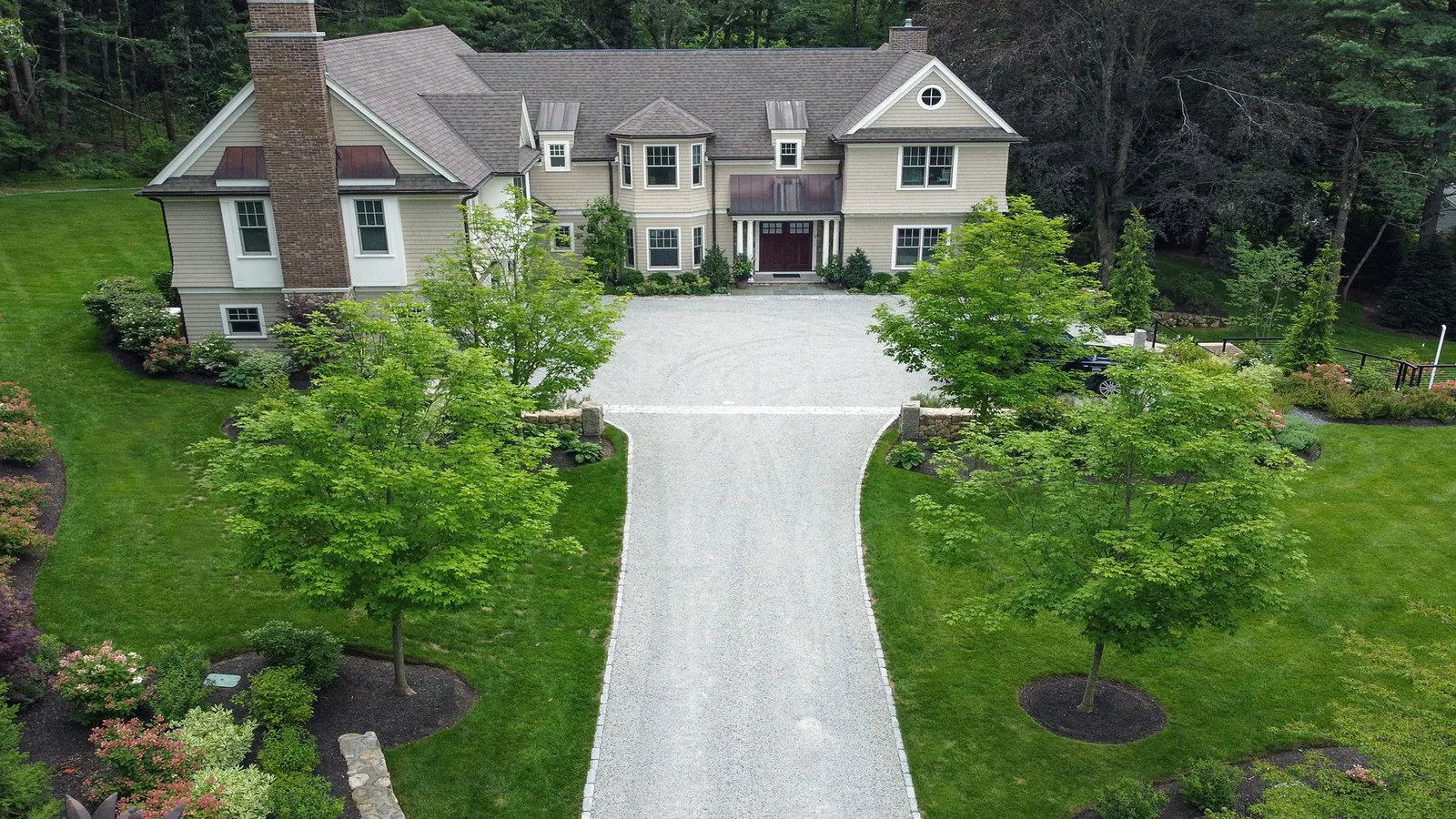
How Much Does a Gravel Driveway Cost in Connecticut?
National home improvement cost guides put a gravel driveway at $1 to $3 per square foot installed. One guide narrows that to $1.25 to $1.80. The same guides report a national average near $1,500. A finished job typically lands between $600 and $1,800.
Those are market numbers, not our price list. What a Connecticut driveway really costs comes down to the lot. How long is the run. How many trees are in the way. Does ledge sit under the topsoil. Where does the water go.
What do the published cost ranges say?
What national cost guides report for gravel driveways in 2026:
| What is being priced | Published range |
|---|---|
| Gravel driveway, installed | $1 to $3 per square foot |
| Gravel material alone | $0.20 to $2.50 per square foot |
| Base gravel by the ton (item 4, base gravel #3) | $12 to $25 per ton |
| Gravel by the ton, across stone types | $30 to $100 per ton |
| Delivery | $50 to $100 per load |
Two things jump out. The stone is the small part of the bill. And the spread is enormous: $300 at the floor and $60,000 at the ceiling in one guide.
That spread is the site, not the stone. It is why a new gravel driveway gets priced after somebody looks at the ground.
What does that work out to by size?
Run the published $1 to $3 per square foot against three common shapes. Twelve feet is a normal lane width.
| Job | Square feet | At $1 to $3 per sq ft | At $1.25 to $1.80 per sq ft |
|---|---|---|---|
| 20 by 20 parking pad | 400 | $400 to $1,200 | $500 to $720 |
| 100 foot driveway, 12 feet wide | 1,200 | $1,200 to $3,600 | $1,500 to $2,160 |
| 500 foot rural driveway, 12 feet wide | 6,000 | $6,000 to $18,000 | $7,500 to $10,800 |
The math is length times width times the published rate.
A long driveway brings more than stone. It brings more clearing, more grading, more stone and more water to move.
What gravel goes into a Connecticut driveway?
A driveway is built in layers. Coarse rock goes down first for strength. Tighter material goes on top to drive on. The FHWA gravel roads guide explains it: big stone makes a strong base but a rough surface.
Names you will hear from a Connecticut supplier:
- Process gravel, also called processed gravel. One Connecticut quarry calls it 3/4 inch or 1 1/4 inch stone with stone dust and sandy gravel. It packs down hard as a driveway base.
- Processed aggregate is the state’s own term. Connecticut DOT Form 818 has a section titled Processed Aggregate Base and Pavement Surface Treatment. Its paved apron spec calls for 4 inches of compacted processed aggregate base.
- Bank run gravel comes out of a sand and gravel bank as it lies. Expect big pieces, roots and rocks. Crushed bank run goes in as a sub base, then gets topped with process gravel.
- 3/4 inch stone is angular crushed stone. It locks together, which rounded landscape stone does not.
- Stone dust is a leveling material in Connecticut, used under pavers and flagstone. One Connecticut quarry does not recommend it for driveways. It will mud up and track.
- Asphalt millings are old pavement ground up and reused. Connecticut DOT calls the material reclaimed asphalt pavement. National guides price millings at $10 to $20 per ton, or $3 to $8 per square foot installed.
Cutting the route and getting the sub base right is excavation work before it is gravel work. The gravel is delivered once the ground under it is ready.
What drives the cost of a driveway here?
Length is the first driver, and that part is simple math. Everything after it is the site.
- Trees and stumps on a new cut. Cost guides put tree removal at $80 to $1,650 each and stump removal at $60 to $360 per stump. Clearing by the acre runs $500 to $3,000. That is land clearing cost, and it lands before the stone arrives.
- Ledge. Fairfield County ground is glacial till over schist and gneiss, so rock turns up close to the surface. Blasting here takes a state license plus a town fire marshal permit. So ledge gets planned for at the estimate.
- Slope and the crown. The FHWA guide recommends about 1/2 inch of crown per foot of width, roughly 4 percent. It says not to go past 6 percent.
- Carrying water off. Without a crown, water sits, softens the surface and cuts ruts into the subgrade. A shoulder that slopes away and a ditch line carry it off. A pipe or culvert is separate work.
- Digging and grading. Guides put excavation at $1 to $2 per square foot. Site prep runs $700 to $2,500 on an average driveway.
- The apron at the road. The town or the state sets the detail where the driveway meets the pavement.
Does gravel cost less than asphalt or concrete?
Yes, by the published numbers. We build in gravel, so read the paved lines as a cost comparison only.
| Surface | Published cost per square foot |
|---|---|
| Gravel | $1 to $3 |
| Asphalt millings | $3 to $8 |
| Concrete | $4 to $15 |
| Asphalt | $7 to $15 |
Cost guides put a whole asphalt driveway at $4,200 to $9,000, averaging $4,740. A concrete driveway runs $1,800 to $6,000, averaging $3,000. Paving is another trade and another contractor.
What does upkeep cost?
A gravel driveway gets topped up. One cost guide puts replenishing the layers every few years at $0.50 to $2.20 per square foot. Regrading and resurfacing run $0.50 to $3 per square foot.
Take the 1,200 square foot driveway above. A regrade at those rates is $600 to $3,600. Fresh stone is $600 to $2,640.
That upkeep is land grading work. The surface gets reshaped, the crown goes back in and the ruts come out. A real sub base and a proper crown cut how often you need it.
Do you need a permit for a gravel driveway in Connecticut?
The town decides, and towns differ. A new driveway meeting a town road touches the town right of way. That is what the town permit covers. In Monroe, public works issues a Highway Modification Permit for driveway construction and a paved apron.
A state route is a different office. Connecticut law bars a new or relocated driveway onto a state highway without a permit from the commissioner of transportation. The state regulation caps an entrance at 30 feet wide. It allows one combined entrance and exit on frontage under 50 feet. Drainage in the state right of way cannot be altered or impeded.
Two more rules can reach a driveway. If the route crosses wet ground or a stream, the town inland wetlands agency looks first. Connecticut defines wetlands by soil type, not by standing water. Disturb more than half an acre and town erosion and sediment control rules apply. Past one acre the state stormwater permit applies too.
The permit comes from the town or the state, not from us. We tell you what your town is going to ask for and line the job up around it.
Ready to get a real number for your driveway?
Published ranges give you a band to plan against. The real number comes from the run, the trees, the ground and the water.
A new driveway is usually one piece of a bigger job. The lot gets opened up. Then the driveway, the foundation and the grade. That is site work, and one contractor can carry it from woods to finished grade.
Call All Star Wrecking at (412) 944-9931 for a free estimate. We look at the site and put the price in writing.